Laboratory is spread over a land of 5 acres is for physical model studies, and is equipped with necessary infrastructure
A water re-circulation system with pumps having discharge of 350 lps (can be extended to 700 lps i.e. around 20 Cusecs) with available head of 10 m.
The Research Laboratory is equipped with various instruments and devices for measurement velocities, water levels, pressures and discharges.
Mathematical Hydraulic Studies
1-D, 2-D and 3-D simulations are carried out to assess various hydraulic phenomena.
Various kind of mathematical simulations are studied using appropriate software according to the project needs.
Hydro-dynamic models.
Morpho-dynamic models.
Sedimentation studies.
The lab is obliged with the guidance of retired CWPRS officers settled in Pune, as and when required.
Model Studies Conducted at
Infraplan Hydraulic Laboratory, Pune, India
for Various Aspects of the Design Parameters
Physical Models
Two-Dimensional Sectional Physical Model for Spillway
Purpose: To evaluate the hydraulic performance of a single, representative spillway block, bay or section.
Application: Used for verifying discharge capacity, rating curves, pressure distribution along the chute, identifying cavitation potential, and testing the efficiency of energy dissipators (e.g., Flip / ski jump bucket, stilling basins, baffle blocks, end sills).
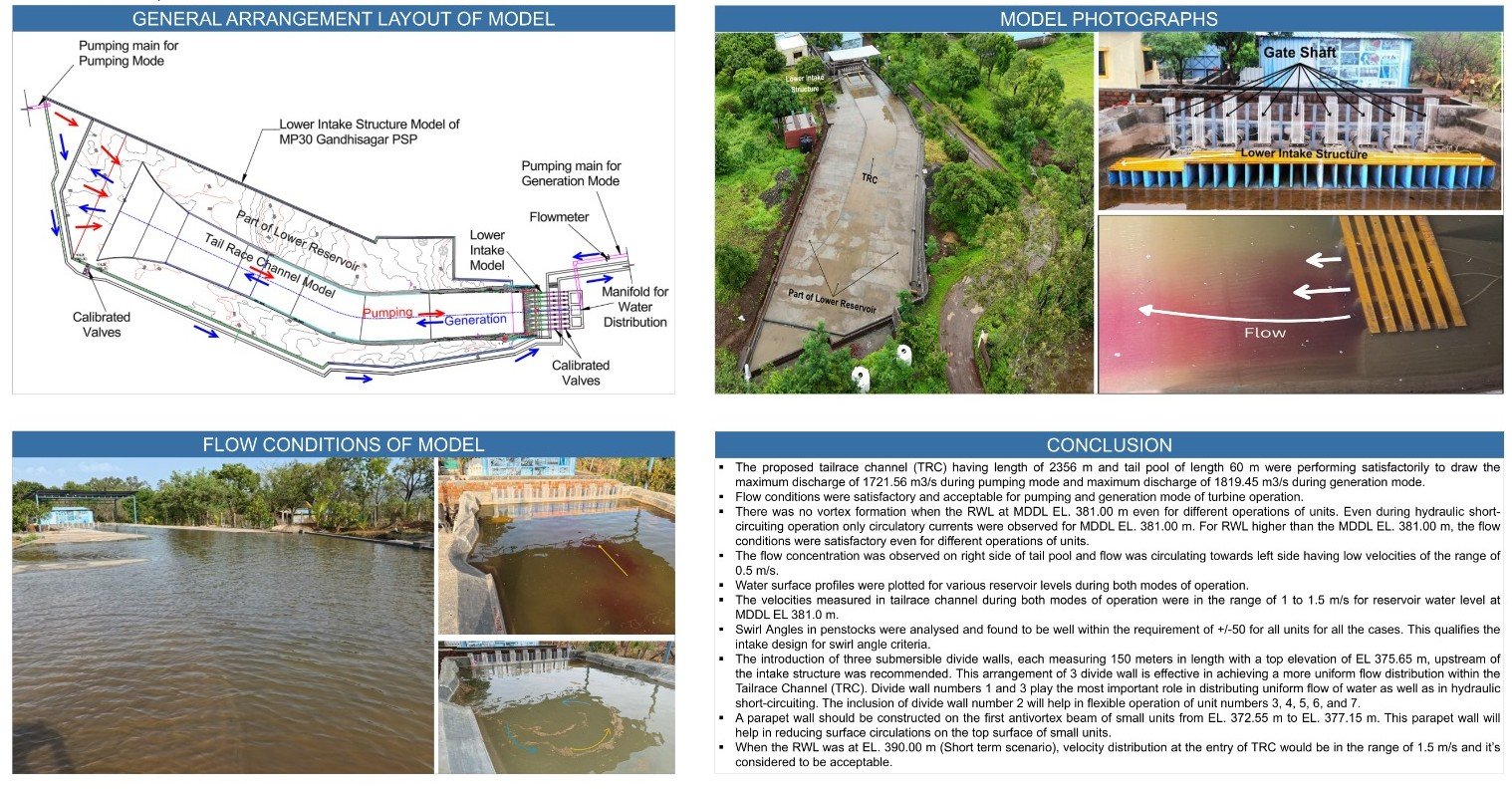
Three-Dimensional Comprehensive Model for Spillway / Barrage and Intake
Purpose: To evaluate three-dimensional flow interactions for a complete spillway / barrage.
Application: Assessing discharging capacity, Essential for assessing complex flow patterns such as flow concentration, asymmetric approach conditions, interactions between intake structures and spillways during combined operations, and downstream river morphology/plunge pool formation.
A part comprehensive model may also be modelled to reproduce representative few bays out of multiple bays, in case of large barrages.
Physical Model for Aeration Studies
Purpose: To study air entrainment and the prevention of cavitation damage on spillway surfaces.
Application: Used to design and optimize aeration ramps or offsets to introduce air into the flow, thereby protecting concrete surfaces from cavitation at high velocities.
Physical Model for Evaluating Hydro-dynamic Forces on Gates (Uplift and Downpull)
Purpose: To measure the hydro-dynamic forces acting on gates during operation.
Application: Used to assess hydrodynamic uplift and downpull forces to verify corresponding hoist capacities, and flow conditions within gate wells. It may also be used n some cases to assess suitability of aeration provisions.
Physical Model combined with Mathematical Model for Sediment Flushing
Purpose: To utilize the strengths of both methods—numerical models for long-term sediment deposition predictions and physical models for visualization and operational optimization.
Application: Mathematical models establish the timing and frequency of flushing based on deposition rates; physical models are then used to optimize flushing methodology (e.g., drawdown flushing), flushing discharge, and the efficacy of flushing tunnels or sediment outlets. The parameters such as, optimum flushing discharge, time required for flushing, quantity of sediments getting flushed are recommended based on studies.
💡 Click arrows to expand for details
Mathematical Models
Mathematical Model for Sediment Studies (2D)
Purpose: To perform one-dimensional or advanced 2D hydraulic simulations, such as water surface profile computation and transient analysis.
Application: Used for flood propagation studies, dam breach analysis, and transient analysis for load rejection/acceptance scenarios to predict water levels and Manning’s n values across river reaches.
HEC-RAS Models for Specific Hydraulic Analysis
Purpose: To evaluate three-dimensional flow interactions for a complete spillway / barrage.
Application: Assessing discharging capacity, Essential for assessing complex flow patterns such as flow concentration, asymmetric approach conditions, interactions between intake structures and spillways during combined operations, and downstream river morphology/plunge pool formation.
A part comprehensive model may also be modelled to reproduce representative few bays out of multiple bays, in case of large barrages.
Transient Studies
Purpose: Transient studies are conducted to evaluate the hydraulic performance of the water conductor system- including the surge tank, headrace/tailrace tunnels and intake structures- during abrupt changes in operating conditions. The primary goal is to ensure that pressure fluctuations, water level oscillations, and mass surges remain within safe design limits during transitions between different operational modes (generations, pumping, and load changes).
Application: These studies confirm the design adequacy of the surge tank and water conductor tunnels, ensuring that neither high-pressure transients nor deep vaccum conditions threaten the structural integrity of the project during routine or emergency operations.
CFD Studies for Spillway, Aerator, Energy Dissipator, etc.
Purpose: To provide high-resolution visualization of flow fields, pressure distribution, and velocity vectors.
Application:Used for preliminary hydraulic optimization, cavitation risk assessment, and detailed analysis of flow behavior over spillway piers, gate bays, and within energy dissipation basins without the immediate need for physical model construction.
IHL is now adopting a complementary approach that integrates CFD studies with physical modelling: CFD analyses are utilized to optimize spillway and structure geometry by evaluating various modifications. Once the geometry is finalized through CFD, it is validated on a physical model, ensuring accuracy while significantly reducing project time and cost.
CFD Studies for Vibration Analysis of Gates Coupled with Finite Element Analysis (FEA)
Purpose: To perform fluid-structure interaction (FSI) analysis by combining fluid dynamic results (CFD) with structural response simulations (FEA).
Application: Used to determine the structural integrity of gates under operational loads, assessing fatigue, stress, and vibration responses caused by hydrodynamic pressure fluctuations.